Blog

"It's that HOMESCHOOLED Kid!" ~ Plus Lots of Ancient Greece Resources

This is how I know our study of history is sticking:   at GMan's tball game last night the heavens opened up and it POURED.  Everyone ran into the dugout.   As the boys are all going stir crazy, GMan looks around and says "I know what happened.   Poseidon sent this storm!"    Ok.  I thought it was witty and clever. I am pretty sure I could read the faces of some of the parents in the dugout, though -- looked something like "Oh ~ he's that homeschooled kid!"  What gave it away?      Or, maybe it was my children riding their scooters in the driveway this morning making up songs about Icarus, Athene, and Heracles... seems like everything we learn transfers to real life.  What a minute -- LEARNING IS REAL LIFE!    


We are beginning our study of Ancient Greece.  Let me tell you, this is probably the most fun thing we have learned about this year.  Once again, I'm learning as much as the kids.   I'm sure we are going to spend several weeks on this period of history.

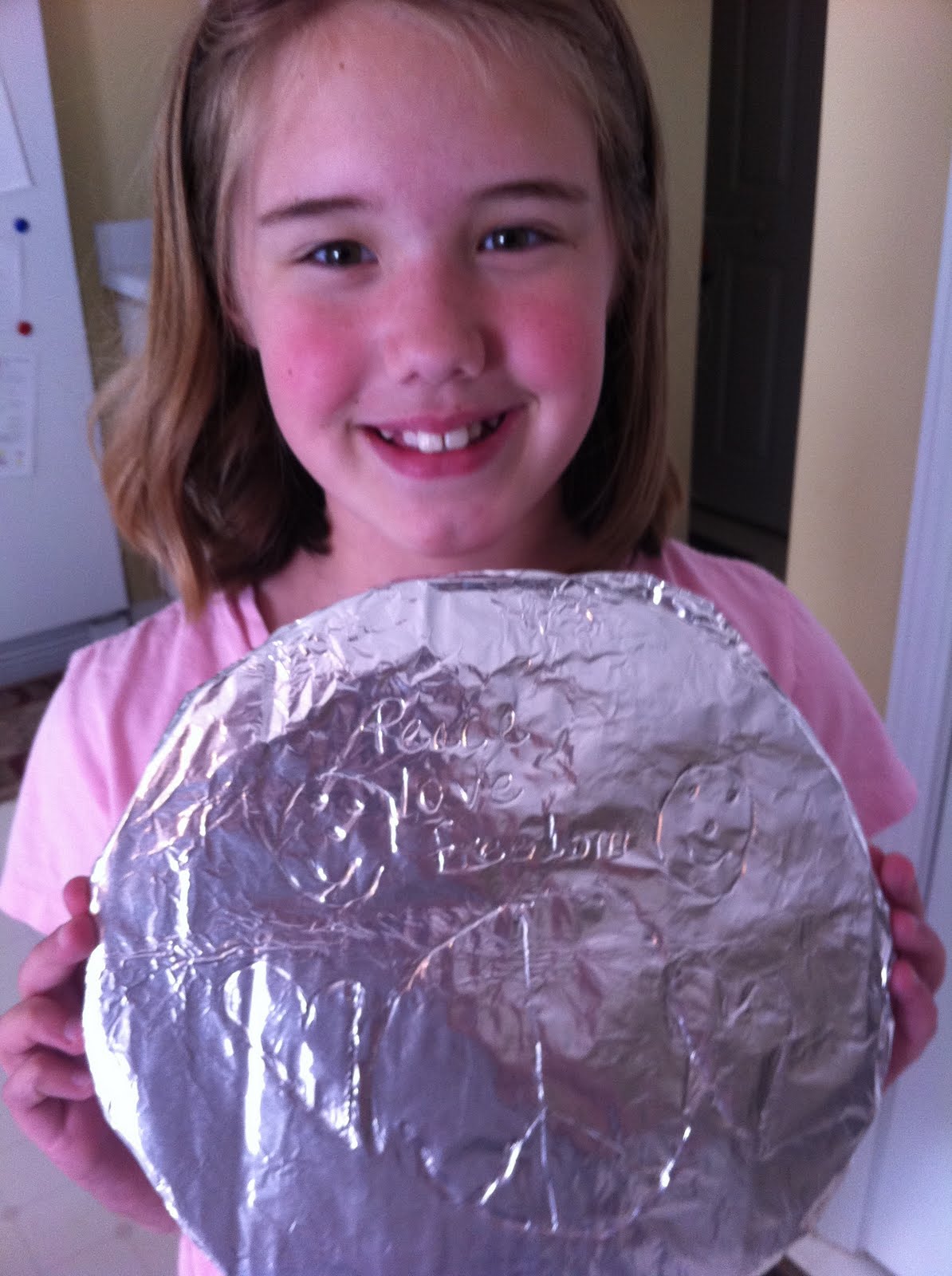
First, a look at a fun and simple hands on activity.  Last week we learned about Persia, and the kids made "Persian Plates" - an activity from the Story of The World.    Basically, they covered cardboard "plates" with aluminum foil and then transferred things that were precious to us onto them.    Hard to tell, but Miss B's has a peace sign, and GMan's has a baseball and him playing baseball.  Shocker.    It was a quick activity which showed them silver was precious to the Persians.  


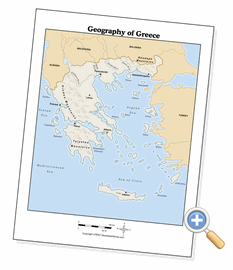
On to some resources we have been using in our study of Ancient Greece ~ thought I'd share!  If you use The Story of The World, these resources correspond with Chapters 20-24.    I am astounded by the amount of quality materials available through our local library and also online.   So many talent homeschool mom put material out there for FREE.  Aren't we lucky?


Greece Comprehensive Map Preview

  • Greek Cooking for Kids -- we love to cook, and a few of these recipes will be going into our menu plan over the next few weeks!

  • You Wouldn't Want to Be a Slave in Ancient Greece -- GREAT book... many others in the series which you can find at the publishers website.   My nine year old loves these.  I give them to her during quiet reading time and ask her to "sticky note" interesting facts to share with me.  


  • Ancient Greece Coloring Pages -- I have a coloring fanatic in my house.   Thank goodness, because he does this while I read aloud to both of the children.   

  • Archimedes Copywork and Notebook Pages -- created by Jimmie of The Notebooking Nook.  Scroll down the page and watch the left hand side for Archimedes to find the downloadable file.  These are printed for my daughter to add to her Ancients Notebook... she loves notebooking!  


and last, but NOT LEAST......

  • Check out this lapbook for The Iliad -- WOW!    We are going to be reading Black Ships Before Troy and I am going to use the character cards as we read.     

We're just delving into Ancient Greece - if you have a favorite resource let me know! 

*Linking up today with Works for Me Wednesday -- because learning history this way works for us!

Photobucket

Our Classical Curriculum - The ABC's of Homeschooling


ABCs of Homeschooling

The letter of the week is C! As I've just returned home from a used curriculum fair and have been thinking a lot about our materials for next year, my post today is about Classical Curriculum.

Our homeschool has evolved into a mostly Classical environment. I'll share with you what we are doing that is Classical, and if you have anything you do, or any suggestions for me, I would LOVE to hear them! I'm a relative newbie on this journey and can use all the help I can get!

I am so thankful for Susan Wise Bauer, author of The Well Trained Mind. This book sits on my shelf and is read OFTEN. This description of Classical Education, taken from The Well Trained Mind website is a great summary:

A classical education, then, has two important aspects. It is language-focused. And it follows a specific three-part pattern: the mind must be first supplied with facts and images, then given the logical tools for organization of facts, and finally equipped to express conclusions.

But that isn’t all. To the classical mind, all knowledge is interrelated. Astronomy (for example) isn’t studied in isolation; it’s learned along with the history of scientific discovery, which leads into the church’s relationship to science and from there to the intricacies of medieval church history. The reading of the Odyssey leads the student into the consideration of Greek history, the nature of heroism, the development of the epic, and man’s understanding of the divine.

This is easier said than done. The world is full of knowledge, and finding the links between fields of study can be a mind-twisting task. A classical education meets this challenge by taking history as its organizing outline — beginning with the ancients and progressing forward to the moderns in history, science, literature, art and music.

(image courtesy Google Images)


This is what our Classical homeschool looks like:

  • History - we are following the 4 year history cycle as prescribed in The Well Trained Mind. To this end, we are using The Story of the World Volume 1 right now, and will be using Volume 2 next year. History is the peg upon which we hang everything else in our homeschool, and WHAT FUN IT IS!


  • Math - we have used Horizons Math from the start. I selected it because it was what came with our Sonlight package the first year of homeschooling. Sonlight has never disappointed me and I feel that they recommend Horizons because of its rigor, mastery, and short spurts of new activities. My children both do well with it and I don't see the need to change. It seems that Saxon Math is the recommended course of study for Classical education - correct me if I'm wrong! I found a very interesting article entitled "An Apology for Latin and Math" - if you have a minute it is quite interesting.
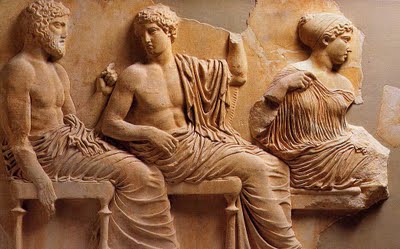
(image courtesy Spurlock Museum)
  • Latin - this is where I'm taking a leap! I just purchased (for $17 for BOTH, I might add!) Prima Latina and Latina Christiana. I think we will start gently (since I will have a first and fifth grader next year) with Prima Latina together and if all goes well progress to Latina Christiana.

  • Writing - I'm struggling here, so could use some suggestions. We used Writing Strands this year and it was pretty much a flop. I'm thinking of Writing With Ease next year. I also am confident that lots of reading produces good writers, so I don't harp on writing too much right now. As my children get older will get more serious about this.

  • Science - This is my weakest area. Currently we are very Charlotte Mason where science is concerned, with a lot of nature discovery and eclectic science units thrown into the mix. I don't know that there is a need for change, because it's working for us, but I wouldn't call our approach to science "Classical".

  • Art & Music - I try to pull in artists and composers from the time period we are studying. Since I have a music degree the music part is fairly easy, and with research, the art falls into place. I don't have a set curriculum for either of these subjects.
(image courtesy Google Images)

I like to be spontaneous and use an occasional unit study or go off on a tangent that interests my children, but for the most part we are a classical home educating family. Do you have any thoughts/recommendations for me? I'd love to hear from some of you experienced homeschoolers out there!

Also, hop over to Five Kids and a Dog to see what other people are blogging about today that starts with the letter C!

*Linking up as well with The Hip Homeschool Hop!
Photobucket